


C is for Cultivating Citizens - Children in the Era of Digital-First Schooling and Data Privacy
In 2026, the global investment landscape has birthed an 'interference' between the physical and the pedagogical. Diversified international investment portfolios are now aggressively fueling high-concept architectural triumphs that serve as 'flagship stores' for international education. We are seeing a synergy where the construction of 'healthy' physical spaces is leveraged to sell the 'prestige' brands of the Western education sector to an aspirational Asian market.
Educational investment mirrors the world of high fashion. Just as consumers reach for heritage brands like John Lewis or Cath Kidston to signal status, Asian education portfolios are increasingly filled with Western 'prestige' brands. We are witnessing a diplomatic and politically charged negotiation unfolding - a digital-age mirror to the 2015 Met Gala’s attempt to reconcile ancient Chinese aesthetics with an edge of Western modernization.
However, as global conflict persists and fuel prices rise across Indonesia, the shadow of PP TUNAS (Government Regulation No. 17/2025) looms with the shifting global conflicts encouraging a pivot toward digital-first schooling. We find ourselves at a critical juncture: is education an ecosystem for growth, or a factory for synthetic harvesting?

The paradox lies in the 'fabrication' of the environment:
The Physical: Schools are being built with contemporary materials like engineered timber, natural earth minerals, and low-carbon concrete to improve children’s biological health.
The Institutional: These modern shells often house a 20th-century industrial revolution model of collegiate rows and rigid hierarchies.
The Digital Scaffolding: AI and Neural Networks
If bamboo is noted as one of the physical scaffolding of the East, then Neural Network Data is the invisible scaffolding of western 2026 education. We have entered an era where contemporary 'progress' is defined by:
Hackathons and Drones: A curriculum focused on high-tech vocationalism.
VR and AI: Mathematics studied via headsets and examinations graded by algorithms.
Data Harvesting: The collection of assessment and gaming data for children under 13, often utilized by external industries for profiling before a child even reaches high school.
This raises a vital question for the contemporary parent: Is a system 'modern' simply because it uses AI, or a mere continuation of an outdated Industrial Revolution/Colonial factory model of high tech education with a traditional veneer?
The Digital Pivot: Fuel Costs vs. Data Privacy
This week amongst rising fuel costs there have been discussions in Indonesia highlighting online schooling being a viable solution to save money. Online education school links and editorial adverts such as the Indonesia expat*5 actively advocate online learning, with kompas.id*4 mentioning how 'Distant learning could be a solution to the current rising fuel costs due to the Middle East conflict exacerbating the condition of education in Indonesia'. Conversely, Jakarata Globe discusses how DPR Lawmakers oppose such plans to revive online learning warning of learning loss and lasting impacts from pandemic era education.*1
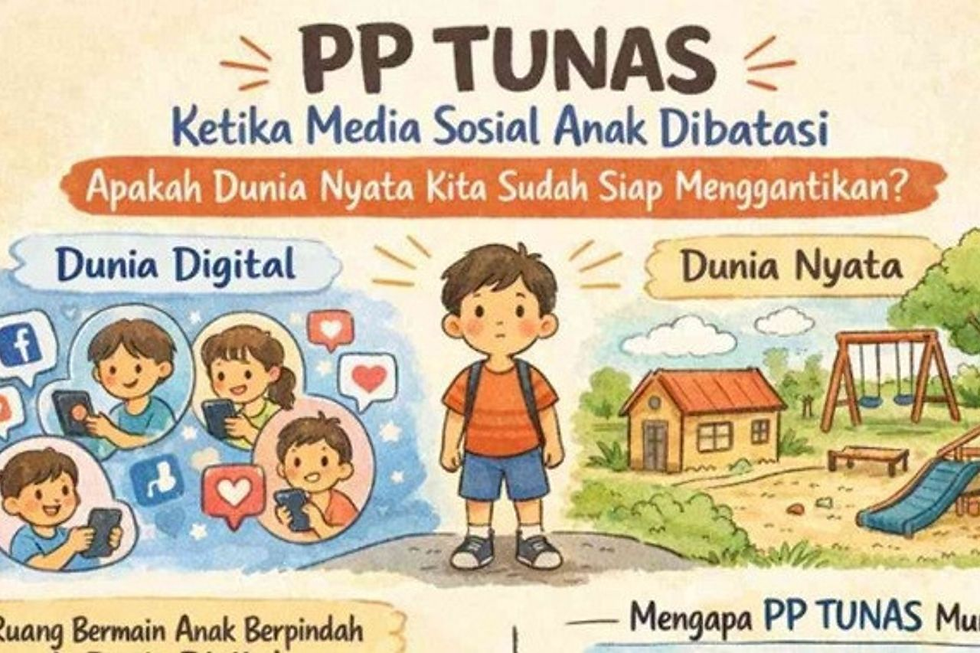
Simultaneously, The Civil Coalition for Digital Literacy has raised significant concerns with the implementation of 'Government Regulation No. 17/2025 concerning the Governance of the Implementation of Electronic systems in the Protection of Children (PP TUNAS)'. Scheduled for full implementation on March 28 2026, the regulation aims to protect minors under 16 from high-risk content and data exploitation. The coalition highlights severe concerns (based on article voi.id *3) of major challenges due to lacking technical readiness of the policy. (massive children's data leakage risks, threats to user privacy, insufficient technical readiness, backdoor access vulnerabilities). PP TUNAS emphasises adequate digital literacy and proper technical implementation is necessary to achieve its protection goals.
A Sustainable Pedagogy?
The Ningbo Museum serves as a metaphor for what contemporary education is currently poised as. By partnering with Nottingham University UK, the museum proves that ancient craftsmanship (the "Wapan" technique) could win the Lu Ban Prize and the Pritzker Prize when merged with modern engineering and AI neural network infrastructure and programmes.
Where neural networks and AI are not part of the museum's physical construction (using the ancient Wapan technique), they are the primary 'invisible scaffolding' for its Digital Heritage initiatives. The centre uses AI-driven photogrammetry and 3D reconstruction algorithms (which rely on deep learning neural networks) to create digital twins of ancient artifacts. They are also utilised in 'Digital Heritage Talks' (2024-2026), The 'Sanjiangkou' Project and with the UNNC AI Research Institute (launched recently) is now applying neural network models to analyze how visitors interact with that very space, effectively 'wiring' the traditional environment for data collection.*1
Education in 2026 in being encouraged via AI with this blueprint. An active exploration of how such neural networks are utilised in tertiary spaces such as Manchester School of Architecture and Oxford Brookes university UK, can illustrate where a truly contemporary framework would not just 'hack' the system with VR; it would encourage sustainability across all sectors - from the operation programming systems to the impact of construction materials on human biology.
Synthetic data
We have mentioned synthetic data in C Word articles across several sectors; various models that are wired as environments to be utilised to collect synthetic data. Such data including models of education biology, neural networks, and household data can be packaged and provide value to governments and constituencies who may utilise data for many different useful programs. In 2025 UK Education conferences exhibited what is possible once such data is collected for teachers and educators post covid.
Conclusion; Decoding neural network veneers
In 2026, as we navigate an era defined by AI assessments and neural data, the 'jury is still out' on whether current education investments truly represent progress. Education is clearly not just a product or a brand but a entire ecosystem. As parents we prioritize and consider schools that successfully consider the biological tax on children learning; sustainable craftsmanship with a commitment to the health and development of the next generation. In 2026, the hallmark of a truly 'modern' education is not found in the prestige of a four-hundred-year-old brand name or the integration of VR headsets. The current war wages how education can be weaponised in the art of war - utilising the minds of our children.
The 'Biological Tax' of Online Learning
We must remember as parents and educators to consider The 'Biological Tax' of Online Learning. With rising fuel costs and the Middle East conflict driving the push for online schooling, Governments actively encourage 'low-carbon concrete' to improve physical health in schools, lest we forget 'online-only' schooling increases sedentary behaviour and blue-light exposure. We must identify where we have created a paradox of mass investments on building 'healthy' schools but then encouraging and telling children and parents to stay home and stare at screens to save on petrol.
The "Black Box" of PP TUNAS
We must question where the government protect children from the AI industry, or is it consolidating the data for the state. PP TUNAS (Government Regulation No. 17/2025) highlights while the regulation aims to protect children, the 'backdoor access vulnerabilities' could lead to state-sponsored profiling.
Synthetic Data vs. Human layered education
If we educate children using models built on synthetic data, we risk creating a 'loop' where education loses its connection to real-world human experience and culture. Education at its best is learning to ask questions through living and failing; real world choices, activities, mistakes, doing the work which generates the intelligent questions and prompts by humans for AI - in turn making AI valuable as an education tool and an encouraging assist to educate children.
As the implementation of PP TUNAS looms and the Middle East conflict drives a shift toward digital-first schooling, we must ensure that children are treated as developing citizens, not merely high-value data models for synthetic harvesting. True progress in 2026 isn't just attending a prestigious 19th Century 'Collegiate Row' school, or neural network 'hacking' and 'flying drones' in the classroom (the vocational 'cogs' for the tech industry); it’s about investments in public and private educational spaces where technology isn't utilised as predictive profiling of minors under 16, where education investment models continue to protect the biology of the learner, rather than exploiting it.
Appendix:
'Lawmaker Opposes Return to Online Classes Under Energy - Saving Policy'
Without Technical Readiness, the Implementation of PP TUNAS Has the Potential to Raise Serious Questions, 18th of March
Online Schooling should be a last minute option to save money.
The Indonesian Expat

Comments