


'C is for Crisis and Continuity': Leveraging AI for Development During Natural Disasters in Asia
Updated: Mar 10
In September, The C Word looks at Asia regions experiencing significant natural events.
This month alone has witnessed three notably documented earthquakes, with the most impactful striking near Jalalabad, one of Afghanistan’s five largest cities and the capital of Nangarhar province - a region bridging North America and Asia in seismic activity ( see table below).


(Nangarhar likely derives from the Pashto words "nang-nahar," meaning "nine streams". This term is thought to refer to nine streams originating from the Safed Koh mountains and is mentioned in some Persian chronicles. Nangarhar itself is the name of a province in eastern Afghanistan.)
Tectonic zone: Hindu Kush–Karakoram Zone; Active subduction and collision → deep-focus earthquakes between the Eurasian and Indian plates. (e.g., near Jalalabad, Afghanistan).
While these regions remain highly disaster-prone, the integration of Artificial Intelligence (AI) offers opportunities to strengthen resilience, improve disaster response, and offer broader benefits in housing, energy, and infrastructure planning:
Housing and urban planning, AI can help identify safe zones, optimize land use, and design disaster-resilient settlements.
In energy systems, AI can improve grid reliability, forecast demand, and accelerate the shift toward renewable sources.
In infrastructure, AI-driven analytics can guide climate-resilient construction, prioritize repair and maintenance, and ensure smarter allocation of public resources.
Regional players have accelerated progress by developing their own AI capabilities -leveraging open-source models, building secure data moats, and gathering intelligence through tools such as drones to monitor farming activity, weather patterns, and environmental changes.
This brief explores both the current natural disaster landscape and the future trajectories in community development, infrastructure, and emerging technologies, including Artificial General Intelligence (AGI) - all poised as the next phase of growth across Asia.
Natural Disasters 2025, 467 quakes recorded


www.volcanodiscovery.com*1 and Chat GPT 5
Last week had seen three specifically documented earthquakes globally. (table above), the biggest between North America and Asia being quakes hit near the eastern city of Jalalabad – among the five largest cities in Afghanistan, and the capital of Nangarhar province. The first quake on August 31 was one of Afghanistan’s worst in years, flattening houses in remote villages. The earthquake impacted water supply in the affected areas. Survivors were forced to rely on unsafe river water, and essential water infrastructure has been severely compromised. The tremors were felt in regions such as Islamabad, Lahore, and other eastern Pakistani areas.
The exact death toll is not available. Reuters reports About 84,000 affected, thousands displaced; September 4th death toll had crossed 1,457 but exact numbers had yet to be compiled. The difficult terrain has badly hindered rescue workers’ relief efforts in the isolated villages.

The C Word has found no specific reported damage to major public facilities (such as universities, hospitals, markets, or government buildings) within Jalalabad itself to have been documented in available news sources. This could imply the only local damage is housing and not public listed buildings.
(Table left: University/institutes in Nangarhar province)
AI systems in development
Pakistan
Pakistan is actively building a sovereign AI ecosystem—with investments in AI labs, sovereign data centres, electricity infrastructure, and supportive policy frameworks.
Oxford Insights (UK) ranked Pakistan 8th out of 17 countries in South and Central Asia on its Government AI Readiness Index*10, evaluating how prepared governments are to deploy AI in public services. (East Asia ranked 3rd).
The Government of Pakistan has taken several steps to promote AI research and development. In August 2025, Pakistan unveiled its National AI Policy 2025 *15, built on six pillars-innovation, talent, security, infrastructure, governance, and international cooperation- with a goal of digital sovereignty.
Real-Time Data Integration for Relief Strategy: In disaster situations, drone feeds in Pakistan are integrated with satellite imagery and CCTV data to create situational awareness, mapping submerged areas, identifying safe routes, and pinpointing relief camp locations. This fusion enabled precise coordination of ambulances, supplies, and dewatering operations to support critical infrastructure. This is an example of leveraging open-source models, building secure data moats, and gathering intelligence through tools such as drones to monitor farming activity, weather patterns, and environmental changes.
Livestock Tracking via AI Mobile App: In September 2025, researchers from Karachi developed ‘Animal Passport’, a free AI-based mobile app that identifies and matches livestock using unique nose prints. This tool aids farmers in flood-prone regions to recover lost animals with high accuracy (99.9%) by scanning visual features and owner-provided details.*7
Smart Agriculture with Drone & AI Integration: The Pakistan-China Joint Lab for AI & Smart Agriculture*9 at the University of Agriculture Faisalabad is employing drones equipped with visual-recognition tech to automate crop monitoring-like irrigation, fertilization, and pest detection-allowing farmers to manage their fields via mobile devices. Enabling High-Tech Farming Infrastructure has become possible with tech firms like AI Force Tech*8 to pilot AI-driven robotic agricultural equipment. These include driverless tractors, electric harvesters, solar-powered charging stations, and digital satellite monitoring, aimed at modernizing farming practices near Lahore.
In May 2025, Pakistan’s National Cyber Emergency Response Team (PKCERT) (also referred to as NCERT or CERT in different sources) issued an advisory regarding a global data breach that exposed over 180 million (up to 184 million) user credentials in an unencrypted, publicly accessible file. The compromised data included usernames, passwords, email addresses, and associated URLs from platforms such as Google, Microsoft, Apple, Facebook, Instagram, and Snapchat, in addition to government portals, banking institutions, and healthcare platforms worldwide. Although Pakistani users were heavily impacted, as of late May 2025, no government or private institution in Pakistan had reported a confirmed breach-meaning the breach was global in nature but did not yet include any confirmed Pakistani-institution-specific data leaks. This would follow on from an earlier leak investigated in March 2024, where NADRA's server compromise affecting 2.7M citizens from 2019–2023. *11
(Reference ‘The C Words’ PDF document of research articles ‘Pakistan's use of AI multi sector overview’)
Pakistan – Baluchistan Province
On March 6, 2025, Baluchistan’s Chief Minister Sarfraz Bugti launched a program to distribute 15,000 solar home systems across the province, funded through a grant from China International Development Cooperation Agency (CIDCA) and South–South Cooperation for Climate Change. At least 5,000 of these systems are prioritized for Gwadar, the "jewel in the crown" of CPEC. *2
Solarization of Public Buildings in Baluchistan
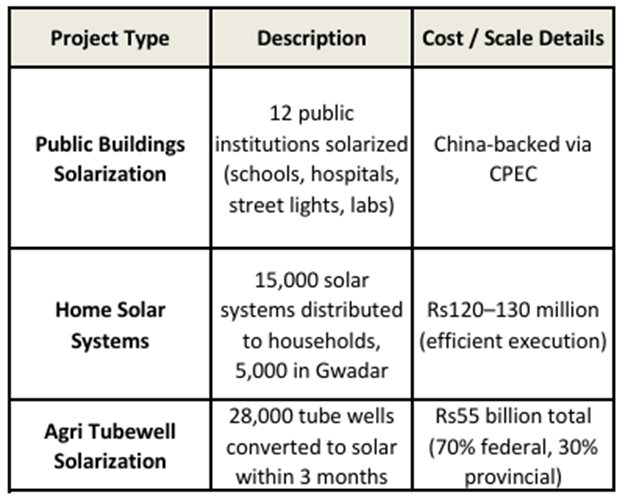
In early February 2024, Baluchistan’s Caretaker Chief Minister Mir Ali Mardan Khan Domki inaugurated a major solarization initiative targeting various public department buildings - educational institutions, healthcare facilities, civic departments, government schools, hospitals, and street lighting across the province* 2. (reference table to left).
These are provincial-level initiatives led by Baluchistan’s government, primarily for improved administration and infrastructure.
Afghanistan, for now, remains a regional collaborator in broader economic initiatives like CPEC, but there’s no specific AI infrastructure development underway—at least not in publicly reported sources. Afghanistan’s recent invitation to join the China-Pakistan Economic Corridor (CPEC) under Beijing’s diplomacy may lay groundwork for future AI or digital infrastructure collaboration. However, no formal AI projects in Afghanistan have been confirmed. *5
Afghanistan
Reconstruction and rebuild across the Afghanistan region has been active discussions in private entities investments and should be important for governments currently taking steps to adopt AI for better governance and infrastructure oversight.

Researched with Chat GPT 5

The UK has pledged £1 million (approximately $1.3 million) in emergency humanitarian assistance. This aid is being delivered via trusted partners - namely the United Nations Population Fund (UNFPA) and the International Federation of Red Cross and Red Crescent Societies (IFRC)—to ensure it does not go through the Taliban government. It’s earmarked for healthcare and emergency supplies for affected populations.
"The UK remains committed to the people of Afghanistan, and this emergency funding will help our partners to deliver critical healthcare and emergency supplies to the most hard-hit," British foreign minister David Lammy said in the online Government statement. *13
The UK’s only role in Afghanistan since 2021 has been humanitarian or development-focused; no recognized government trade or investment deals have been made with the current Taliban administration. Meanwhile, it has been documented that some UK-connected private entities have engaged in mining contracts directly with the Taliban government—but these are not official trade agreements.
Disaster Response Readiness using AI
The adoption of Artificial Intelligence (AI) can play a pivotal role in improving disaster prediction, preparedness, and response. Empowering local partners to implement AI solutions, especially through open-source models, will help build considerable resilience.
Pakistan is well-positioned to integrate AI-driven disaster forecasting, resilient communication platforms, and regional leadership in disaster cyber-preparedness. Pakistan’s reported use of DeepSeek to forecast heavy rainfall and potential flooding in Sindh and Baluchistan weeks in advance demonstrates how such tools can provide actionable intelligence and safeguard lives.*3, 4
Baluchistan is Pakistan’s most disaster-prone region (earthquakes, floods, droughts, cyclones). The current Cyber-capacity gap at the provincial level is resulting in fewer secure systems for disaster coordination. Baluchistan can benefit from Pakistan’s national Tier 1 Cybersecurity ranking*14, since federal systems cover provinces. But local infrastructure (internet, electricity, emergency networks) remains weak and insecure, limiting the real-world impact of Pakistan’s GCI (Global Competitiveness Index)*16 ranking on Baluchistan's ground-level disaster response.
Regional disparities could widen unless provincial digital capacity building is prioritized. Baluchistan can share in Pakistan’s broader success only if provincial-level targeted investments are made to strengthen local disaster-response infrastructure, particularly in cyber and data systems.
Within Asia’s proposed interdependent AI framework, Afghanistan’s disaster management is likely to remain fragile, reactive, and heavily reliant on international humanitarian aid. In the absence of adequate cyber-capacity, the country faces significant risks:
· Delayed warnings (floods, droughts, earthquakes).
· Data leaks or manipulation in aid distribution.
· Current difficulty participating in regional early-warning networks (Asia).
Post disaster immediate solutions for Afghanistan could include developing an AI (possibly open source) LLM ( learning Language Model) that can be rapidly repurposed as a force-multiplier to help people in Nangarhar find clean water and safe refuge after the August 2025 earthquake - if it’s used as part of a pragmatic, secure pipeline that combines satellite imagery, ground reports, SMS/IVR, and humanitarian coordination.
The eastern Afghanistan quake (epicentre near Jalalabad/Nangarhar) caused widespread destruction, displaced tens of thousands, destroyed water infrastructure and blocked roads - creating urgent needs for water and shelter.
There are ongoing local water projects and community water points in Nangarhar that can be mapped and leveraged when routing supplies. *6
A low cost LLM (learning Language Model) adds value because it can understand multi-lingual, noisy text (SMS, hotline transcripts, social posts), fuse that with geospatial/satellite signals, prioritise needs, and produce human-readable action plans for field teams - far faster than manual coordination alone.
Cost/Benefit of adopting AI for disaster preparediness
Considerations such as using a Self-Host open source LLM would result in upfront infrastructure operations (the management and maintenance of the hardware, software, and networking components) burden, but lower marginal cost.
In natural disasters, the cost/benefit ratio heavily favours implementation. A simple AI research cost benefit model below illustrates the upfront burden of self-hosting is dwarfed by the lives saved, economic savings, and national sovereignty benefits:
Researched with Chat GPT 5 Cost versus Benefits Diagram
Cost versus Benefits Diagram ( Right)
Top-right: High cost, high benefit (lives saved, operational efficiency).
Top-left: High benefit, low cost (reputation, reusable infra).
Bottom quadrants: Cost drivers that don’t directly bring benefits (infra, ops burden, inference cost, staffing gaps)
This makes the overwhelmingly positive case for implementation - benefits clearly outweigh costs.
Funding for a government-owned LLM (learning Language Model) for Baluchistan, Afghanistan:
Afghanistan’s and Baluchistan's disaster management will remain fragile, reactive, and highly dependent on international humanitarian aid. (e.g., UNICEF reports for eastern Afghanistan in September 2025 requires US$ 21.6 million to support a six-month response plan of which US$ 5.2 million is currently available, leaving a funding gap of US$ 16.3 million).*12
Strategic National Interest
Disaster resilience: Funding a local LLM for emergency management strengthens national capacity to respond to earthquakes, floods, or pandemics without relying on foreign AI.
Digital sovereignty: By owning the model and data pipeline, the government ensures sensitive citizen or disaster-response data remains under local control, reducing foreign dependence.
National security / civil protection: Real-time analysis of disasters, migration, and infrastructure damage can aid defence, civil protection, and humanitarian planning.
Economic & Commercial Gains
Monetization of AI technology:
Once developed, the government can license the LLM (or derivatives) to private companies (telecoms, health, logistics) or regional governments, generating revenue.
Proprietary AI services (e.g., multi-lingual NLP, SMS-based citizen engagement) can be commercialized domestically and internationally.
Data as an asset:
Aggregated, anonymized data on disaster reports, water/shelter distribution, and infrastructure usage can be monetized for planning, insurance, agriculture, and urban development.
These data streams have become a national economic asset, contributing to commerce and policy decisions.
Technical & Human Capital Development
Building AI expertise locally: Government funding creates local AI jobs and builds skills in machine learning, NLP, geospatial analysis, and systems integration.
Transferable capabilities: A government-owned LLM can later be applied to healthcare, agriculture, education, commerce, and smart city initiatives - not just disaster response.
Public-Private Collaboration & Economic Multiplier:
Stimulate local tech industry: Funding the LLM allows domestic start ups and universities to participate, which can lead to new companies and revenue streams.
Economic multiplier effect: Spending on compute infrastructure, cloud, and AI operations circulates money into the domestic tech ecosystem, creating jobs and innovation clusters.
Once developed, the government can license the LLM (or derivatives) to private companies (telecoms, health, logistics) or regional governments, generating revenue. These data streams become a national economic asset, contributing to commerce and policy decisions.
Reputation & Global Standing:
Successfully deploying AI in disaster management signals technological advancement, attracting international development funds, partnerships, and foreign investment.
Participation in global initiatives (like the Global Cybersecurity Index, AI Readiness index) reinforces the country’s reputation as a tech-forward, resilient state.
Conclusion:
Earthquakes in Afghanistan, particularly near Jalalabad, reveal the ongoing risks to communities, infrastructure, and essential services such as water supply.
Humanitarian responses-including UK aid and UN-backed relief-demonstrate a critical role of global support in mitigating immediate crises.
At the same time, the region is witnessing a surge in investment and technological initiatives. From provincial AI initiatives in Baluchistan and Pakistan’s national push for sovereign data centres, to global progress in Artificial General Intelligence (AGI), these efforts reflect a vision that links resilience with technological advancement and strategic infrastructure planning (see The C Word article “C is for Continuity: AGI Development in Asia”).
AI readiness
When viewed through the lens of AI readiness, the contrasts are clear. Pakistan, (listed Tier 1 in the Global Cybersecurity Index and Group 8 for AI readiness), is advancing but faces critical challenges in public trust and resilience. Afghanistan, by comparison, remains in Tier 5 with minimal readiness, while Baluchistan is not yet listed. *14 Crucially, AI readiness is not defined by technology alone - it also hinges on citizen trust, institutional capability, and the ability to safeguard against foreign AI influence, particularly through social media. Trust gaps, such as those exposed by the NADRA breach (2019–2023), highlight how data insecurity undermines confidence in digital governance and slows adoption across vital sectors like healthcare, identity, and taxation.

Right now, Pakistan is making strides in policy and pilot projects but still faces serious vulnerabilities in trust and resilience. Research such as Oxford Insight’s Government AI Readiness Index doesn’t implicitly measure trust, but its “Governance” pillar (legal frameworks, transparency, accountability) is linked to public confidence. In Pakistan, trust gaps exist; research shows citizens often express scepticism about how data is used by state institutions (e.g., NADRA leaks, global breaches). When citizens do not trust the government to manage data responsibly, AI adoption slows - especially in sensitive sectors like health, identity, and taxation. The NADRA breach (2019-2023, revealed 2024) showed how data insecurity directly undermines confidence in state-led digitization. Without reassurance (e.g., independent audits, transparency laws), citizens, as evident globally, may resist AI-based ID verification, healthcare platforms, or smart governance tools.
Our overview illustrates that Asia is navigating a delicate balance between risk and opportunity. Integrating sustainable development, technological innovation, and community-focused planning will be essential to building a more resilient and prosperous future. The road ahead depends on how effectively investment, innovation, and international collaboration can be harnessed to shape a safer, more resilient, and technologically empowered future for Afghanistan, Baluchistan, and Pakistan.
Appendix:
2 . Solar Baluchistan article
4 Deep Seek Weather Prediction
7 Pakistan AI Apps help farmers trace livestock
10 AI Readiness Oxford insights
11 The C Words research - Pakistan's use of AI multi sector overview
12 Unicef - Afghanistan Flash update Eastern region, September 2025 https://www.unicef.org/documents/afghanistan-flash-update-earthquake-eastern-region-first-week-07-september-2025
13 UK Government's Press Release , emergency aid to Afghanistan earthquake victims
15 Pakistan AI Policy ( Draft) Only copy currently found online 10th September 2025
16 Global Competitiveness Index (GCI)
Comments