


C is for Changes in Emigration, UK
Updated: May 25
The UK is experiencing a historic demographic shift: more people are leaving for the EU than arriving. Thanks to rigid post-Brexit rules and a cooling economic climate, net EU migration has dropped to a striking -42,000 to -70,000 [more people leaving than arriving]. But, crucially, this exodus isn't limited to EU and foreign nationals heading home; it includes an unprecedented number of young British working professionals aged 24 to 35 packing their bags too. What is driving this sudden flight of talent? Where are these young adults planning to establish themselves after 2026? This brief examines the drivers behind this historic emigration, looks at where Britain's youth plan to build their futures post-2026, and asks the question: do they ever plan to return?

For those including myself who need to know the difference Emigration is the act of leaving your home country or region to settle permanently in another.
Emigration ((E) for (Exit)): The act of leaving your home country to move elsewhere. You emigrate from a place.
Immigration ((I) for (Into)): The act of entering a new country to live there. You immigrate to a place.
These words usually describe the exact same journey, but from opposite points of view. For example, a person who leaves Germany for the United States emigrates from Germany and immigrates to the US.
UK Trends
An estimated 246,000 British nationals emigrated from the UK in the year ending December 2025, which is slightly lower than the 257,000 who left the previous year. Because more Brits leave than return, the UK currently experiences negative net migration for its own citizens of roughly 136,000 annually. (Negative net migration means the number of departures outpaces the number of arrivals) which means significantly more British nationals are emigrating from the UK than are immigrating back.

The other notable distinction is the age group; The gap between those leaving and arriving has grown fastest for 25 to 34 year olds.
Long-term international migration of British nationals into and out of the UK by age group, year ending December 2022 to year ending December 2025.
Image courtesy*1 UK Office for National Statistics
Long-term international migration data shows that the majority of British nationals moving into and out of the UK belong to the 25-34 age demographic. So, where exactly are they going?
EU+ Trends
Romanian continues to be the most common non-British EU+ nationality, with Polish nationals representing one of the other highest contributing European groups. Poland appears to be an increasingly common destination for British-born people, according to the UN’s database; the population there increased from 42,000 in 2015 to 185,000 in 2024.The spike in British nationals moving to Poland and Romania is heavily driven by reverse migration. In this article we will focus on just these two countries to understand the 2026 emigration choices of UK citizens within the EU. *3

Following Brexit, tens of thousands of Polish and Romanian citizens who spent years working in the UK moved back home. In a 2020 report, Statistics Poland noted that Polish citizens returning home with children born in the UK helped make the UK one of the primary countries people were migrating from. Driven by Poland's booming economy, affordable housing, low crime rates, and lower cost of living, this ongoing trend encompasses both British professionals and the British-born children of Polish returnees.*3
This emigration trend is also shared by English-speaking Brits. Many multinational corporations and booming tech sectors in major Polish hubs hire English-speakers. Warsaw, Kraków, and Wrocław are the dominant tech hubs in Poland that actively employ British-born and English-speaking citizens. Because Poland is a major European centre for Business Process Outsourcing (BPO) and Shared Services Centres (SSC), hundreds of global multinational corporations operate entirely in English. As the largest economic and tech hub, Warsaw is home to major international cloud, AI, and enterprise tech centres. Poland offers roughly three times the volume of tech roles and a vastly larger total tech talent pool (over 650,000 tech professionals compared to Romania's roughly 200,000). Furthermore, Poland focuses heavily on massive multinational Research & Development (R&D) and Shared Services hubs where English is the primary operational language, whereas Romania's tech economy leans more toward third-party software outsourcing and vendor contracting.
City & Hub Profile | Key Employers | Core Specializations & Target Talent |
Warsaw (The Capital Hub) Poland's largest economic and tech epicenter. Hub for major international cloud, AI, and enterprise ecosystems. |
Microsoft
Samsung
ING Hubs | • Massive Cloud Engineering Hub hiring software developers, architects, and tech support.
• Extensive local cloud development and tech units.
• One of its largest global R&D centers; heavy focus on software engineering and AI.
• Global operations hub delivering cybersecurity and digital banking solutions. |
Kraków (The Tech & Outsourcing Capital) Boasts the country's highest concentration of ICT specialists and international tech providers. | Capita
Sabre Corp.
Motorola
Cisco | • UK-based giant actively sourcing British and native English-speaking talent.
• Global travel tech giant operating a massive software development hub.
• Long-standing employer focused on critical communication software.
• Highly multicultural Global Delivery Center operating entirely in English. |
Wrocław (The Innovation Center) Famous for an incredibly collaborative startup ecosystem and massive corporate R&D branches. | Nokia
Wipro & Capgemini
Qualtrics | • Extensive European software development and telecom innovation center.
• IT consulting giants continually recruiting international talent for infrastructure and support.
• Growing product presence hiring English-speaking developers and account managers. |
Research courtesy of Gemini AI
The Student Exodus
Additionally British-born citizens are increasingly traveling to both Poland and Romania to study, driven primarily by English-taught medical and veterinary programs.
While overall undergraduate mobility from the UK to Europe shifted after Brexit, Poland and Romania have emerged as premier destinations for British medical, dental and veterinary students. This is because both countries offer high-quality degrees taught entirely in English at a fraction of UK tuition costs, with much less competitive admission caps.
The Medical and Veterinary Surge
The vast majority of British students in these two countries are enrolled in healthcare fields:- Poland: Universities like the Medical University of Warsaw, Jagiellonian University Medical College (Kraków), and Wrocław Medical University host hundreds of British students. Poland's medical programs are highly regarded because their degrees are recognized across Europe and globally.
Romania: Cities like Cluj-Napoca, Iași, and Timișoara have become major hubs for British undergraduates studying medicine and veterinary medicine. The University of Agricultural Sciences and Veterinary Medicine Cluj-Napoca is particularly famous for its English-taught veterinary degrees, which attract large cohorts of British students who face hyper-competitive caps back home.
Financial and Academic Advantages
British students are choosing these destinations due to distinct practical benefits:
Lower Tuition Fees: UK medical schools cost £9,250 per year for domestic students, but spaces are strictly limited. In Poland, English-language medical programs range from £10,000 to £14,000 annually. In Romania, fees are even lower, averaging around £4,500 to £7,500 (€5,000–€8,500) per year.
Massive Cost of Living Savings: The day-to-day cost of living, student accommodation, and food in Polish and Romanian university towns is up to 40% to 60% cheaper than in major UK student cities like London, Manchester, or Bristol.
Straightforward Entry Requirements: While British universities rely heavily on specialized entrance exams and near-perfect A-level predictions, Polish and Romanian universities prioritize localized science entrance tests or high performance in Biology and Chemistry A-levels.
However these come with Post-Brexit Immigration Realities.
Because the UK has left the EU, British students can no longer simply pack a bag and move. They face distinct travel rules.*4
Class of 2026: The Great British Student
Back in the UK, India was the most common non-EU+ nationality to immigrate long-term to the UK.


As noted on ONs website, the graph ( Figure 6) above shows that, for the top five nationalities, study-related immigration was the most common reason. Indian, Pakistani, Chinese, and Nigerian are regularly among the top five most frequent non-EU+ nationalities for long-term immigration.
Across all three nationality groups, the majority immigrating were working-age males. The graph (Table 1) above shows that there were more males than females across all three nationality groups. The majority of those immigrating long-term in YE December 2025 were working age (aged between 16 and 64 years), including:
87% were non-EU+ nationals
86% were British nationals
82% were EU+ nationals
Conclusion: The Nature of UK's exodus of the working young
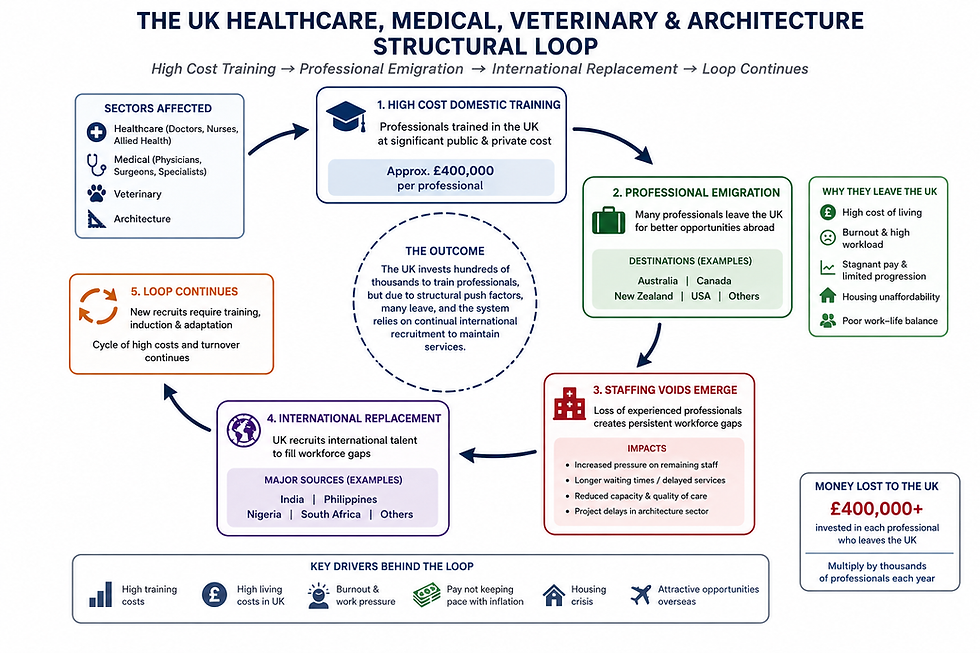
High domestic competition, strict enrollment caps, and the surging cost of living have driven a significant number of British students to seek degrees and tech careers abroad.*5 Student Professional Disciplines like architecture, healthcare, medical and veterinary fields are currently filled with international students. British students are studying the same disciplines in countries such as Poland, Romania , Canada and Australia.
British students and young professionals have split their migration strategies into two clear avenues:
Poland & Romania: The European Healthcare Backdoor
As discussed, these destinations are primarily seem to be used for educational arbitrage in healthcare.
The Pull: British students who miss out on hyper-competitive UK medical or veterinary seats migrate here to study medicine, dentistry and veterinary science taught entirely in English.
The Strategy: They are not typically moving to settle long-term. Instead, they use the highly affordable tuition and low cost of living as a stepping stone, planning to return to the UK to register with the General Medical Council (GMC) or Royal College of Veterinary Surgeons (RCVS) once they graduate.
2. Canada & Australia: The Permanent Career Emigration
Unlike the temporary educational moves to Eastern Europe, British students heading to Canada and Australia are looking for long-term lifestyle changes, higher salaries, and permanent residency.
Tech & Architecture: Australia and Canada face massive domestic housing and infrastructure booms. British architecture and tech graduates use Working Holiday Visas or Express Entry / Skilled Independent Visas to migrate. Salaries for junior developers and architectural designers in cities like Melbourne, Sydney, Vancouver, and Toronto can outpace early-career UK wages by 30% to 50%.
The Healthcare 'Brain Drain': Fully qualified British doctors, nurses, and veterinarians are migrating en masse to Australia and Canada. Burned out by NHS working conditions, British healthcare professionals find that Australia and Canada offer fast-tracked immigration pathways, significantly higher pay, better hours, and a superior climate.
This has left the UK healthcare model to heavily rely on importing fully qualified professionals from abroad to plug its vacancy gaps. *5

The consequences of net negative migration specifically among British citizens-offset by high overall immigration-are reshaping the UK workforce, public services, and demographics.
Economic and Workforce Shifts
Skill Drain: Critical sectors suffer as highly educated young professionals leave the country.
Healthcare Strain: The NHS faces worsening shortages as British doctors and nurses relocate abroad.
Tax Base Reductions: Higher-earning emigrants reduce long-term income tax revenues for the state.
Labour Mismatches: Industries must rely heavier on international recruitment to fill specialized vacancies.
Social and Cultural Impact
Brain Drain: The loss of young innovators slows domestic research and entrepreneurial growth.
Family Disruption: Multigenerational support networks weaken as younger families move overseas.
Demographic Aging: An outflow of young adults accelerates the aging of the remaining UK population.
Financial and Public Service Pressure
Pension Imbalance: Fewer working-age citizens are left to fund a growing retiree population.
Training Losses: The state loses its financial investment in subsidized university and medical degrees.
Shifted Demand: Reduced domestic pressure on housing is countered by immediate infrastructure demands from broader immigration.
Now UK students and young work force are part of a massive shift in global education and migration. UK high domestic competition, strict enrolment caps and surging cost of living have driven significant number of British students to seek degrees and tech careers abroad. The movement is split between cost arbitrage European moves ( Poland, Romania) and long term emigration to Anglosphere countries.
Post 2026, UK civilians education, work, and public infrastructure has fundamentally shifted. The traditional lifecycle-training domestically, working locally in a single public system, and retiring in the UK-is being replaced by a globalized market.
To thrive post-2026, UK citizens must understand that they operate in a borderless market for talent, where localized shortages are solved through international recruitment rather than domestic expansion.
While returning to work as a senior professional is highly viable, retiring back to the UK as an expat faces steep structural and financial hurdles.
The Housing Wealth Gap: If you do not maintain a foothold in the UK property market while working abroad, buying back into the UK at retirement age will be incredibly expensive. Property values in desirable retirement areas remain decoupled from average local wages.
The Private Healthcare Necessity: By the time a 25 to 34 year old reaches retirement age, the UK's two-tier health system will be deeply entrenched. Relying entirely on a constrained public health system for age-related care will be difficult, meaning you will need significant international savings to fund private comprehensive healthcare policies.
Taxation on Global Wealth: The UK maintains strict tax rules regarding offshore assets, foreign pensions, and statutory residence. Transferring wealth accumulated in Australia, Canada, or Europe back into the UK post-work can trigger complex tax obligations that diminish your purchasing power.
There is momentum for British students to gain high-value skills abroad and then leverage those skills to whichever organization offers the best compensation package. A preferred outcome is to create a High cash flow to fund private healthcare and independent retirement which may not be available to them in their later years.
Currency; Geographic Arbitrage via Remote Fintech Contracting
The rise of borderless fintech infrastructure (like Revolut, Wise, and Deel) allows young professionals to live in lower-cost tech hubs (like Poland or Romania) while billing companies in high-wage economies (like the UK, US, or UAE).
The Mechanism: Instead of earning a localized salary subject to high domestic taxes, you operate as a B2B contractor.
The Cash Flow Result: You pull a premium Western tech or finance salary, process it through low-friction digital business accounts, and spend it in an economy where your living costs are 40% lower. This creates a massive monthly surplus that can be funneled directly into private investment vehicles.
Utilizing Crypto and DeFi for Capital Accumulation
Cryptocurrency and Decentralized Finance (DeFi) provide young adults with an alternative wealth-building pipeline that operates entirely outside of traditional, low-yield UK banking systems.
Liquid Wealth Generation: Instead of locking capital away in rigid, low-interest domestic pension pots (like a UK ISA or workplace pension) that you cannot touch until your late 50s, young professionals use crypto assets to build liquid capital.
Self-Custodied Security: High-yielding stable coin lending, tokenized real-world assets (RWAs) allow for rapid asset compounding. This liquidity ensures you have immediate cash access to cover international private medical insurance or invest in offshore assets without navigating traditional cross-border banking friction.
Neobanking and Global Investment Portfolios
Modern digital banking eliminates the old barriers to building an international asset base.
Instant Diversification: Using global neobanks and borderless brokerage apps, a 25 to 34 year old can instantly split their earnings into multiple currencies (USD, EUR, GBP) and globally diversified equities.
Insulation from Local Decline: If the UK economy faces stagnant growth or currency depreciation, your wealth remains insulated because it is held in global assets. This ensures that when you eventually need to fund private healthcare or retirement, your purchasing power is tied to global markets, not a single domestic currency.
By leveraging fintech, crypto, and modern banking, you take full control of your financial infrastructure. You stop relying on a state system to look after your health and retirement, and instead build a private, digital wealth loop that keeps you financially independent, no matter where you choose to live.
This decoupling of finances from a state system inevitably decouples your identity from it too.
For Millennials, Generation Z, and Generation Alpha, what it means to be 'British' has fundamentally shifted. They are moving away from traditional institutional patriotism and moving toward a fluid, values-based, and globalised identity.
Ultimately, to these younger generations, being British is no longer an economic or institutional anchor. It is a cultural baseline - for Millennials, Gen Z, and Gen Alpha, a cultural baseline can represent a psychological separation between the State (the government, the economy, the physical land) and the Culture (the music, the values, the mindset). An identity linked with social and behavioural, rather than institutional. Because they feel the modern British state has failed to offer them a stable economic future, they opt out of the state apparatus via digital wealth and emigration. But they don't necessarily opt out of the culture. By using modern banking and crypto to take control of their financial infrastructure, they carry their 'Britishness' with them as a passport they hold and a mindset they naturally possess, but it is no longer a border that contains their wealth, career, or future. It is where they start, not where they have to finish building their lives and will head wherever the economic and cultural climate of Britain is directed and suits them best.

Appendix
4 * UK Student travel rules
https://erudera.com/statistics/uk/uk-international-student-statistics
Visas Required: For any program longer than 90 days, British students must secure a National D-type Student Visa before leaving the UK.
Residency Steps: Upon arriving at their university city, they must convert this visa into a local temporary residence permit - a Student Karta pobytu in Poland or a Temporary Residence Permit in Romania - valid for the duration of the academic year.
Healthcare & Funding: British students must prove they possess private comprehensive health insurance and sufficient monthly funds to support themselves without relying on local state welfare
5* Commons Library Research Briefings Healthcare


Makes alot of sense. Thanks